
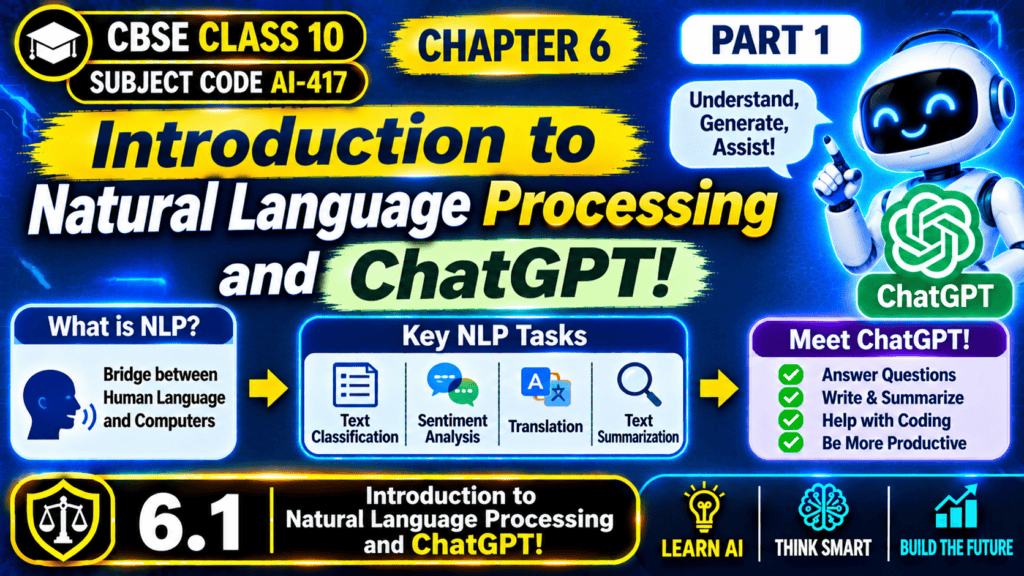
This article is for 6.1: Introduction to NLP, Applications & Chatbots of Unit 6 Natural Language Processing for AI-417 CBSE course for Class 10. In this article we open up Natural Language Processing (NLP), the branch of AI that teaches machines to make sense of the messy, ambiguous, wonderful way humans actually talk, and that sits quietly behind every chatbot, voice assistant, and AI writing tool you’ve ever used.
What Is Natural Language Processing?
A natural language is simply a human language: English, Hindi, Spanish, Japanese, and so on, as opposed to a computer language like Python, C++, Java, or HTML, which computers are built to understand directly.
Natural Language Processing (NLP) is the sub-field of AI focused on enabling computers to analyze, understand, and process human languages, in order to derive meaningful information from them. Computers can only process electronic signals in the form of binary language. NLP is the bridge that converts our natural, spoken and written form into something a machine can actually work with. It’s this same bridge that lets a tool like ChatGPT take your typed question and turn it into something it can actually act on. The whole purpose of NLP is to make communication between computer systems and humans possible.
Features of Natural Languages
Before we can teach a machine to handle human language, it helps to appreciate just how tricky that language really is:
1. Governed by rules
Every natural language follows a set of rules covering syntax (grammar), lexicon (vocabulary), and semantics (meaning).
2. Redundant
The same information can be conveyed in multiple different ways. “It’s raining outside” and “There’s rain falling right now” mean the same thing, phrased completely differently.
3. Constantly changing
Natural languages evolve over time. New words enter, old words fall out of use, and meanings shift.
And on top of the rules, there’s ambiguity everywhere. Same-sounding words can mean entirely different things like “bat” the animal versus “bat” the cricket equipment, or “write” versus “right.” Even a single word can shift meaning depending on context. Consider these three sentences, all using the word “red”:
- His face turned red after he found out he took the wrong bag. (Is he ashamed? Angry?)
- The red car zoomed past his nose. (Just describing color.)
- His face turns red after consuming the medicine. (An allergic reaction? A side effect?)
We resolve meanings like these almost instantly, drawing on our history with the language and the surrounding context. Teaching a machine to do the same is exactly the challenge NLP takes on, which is precisely why NLP is important. It’s the toolkit that lets computers understand intent and context, not just individual words.
Applications of Natural Language Processing
NLP has quietly become part of daily life for most people. Here are six applications you’ve almost certainly used:
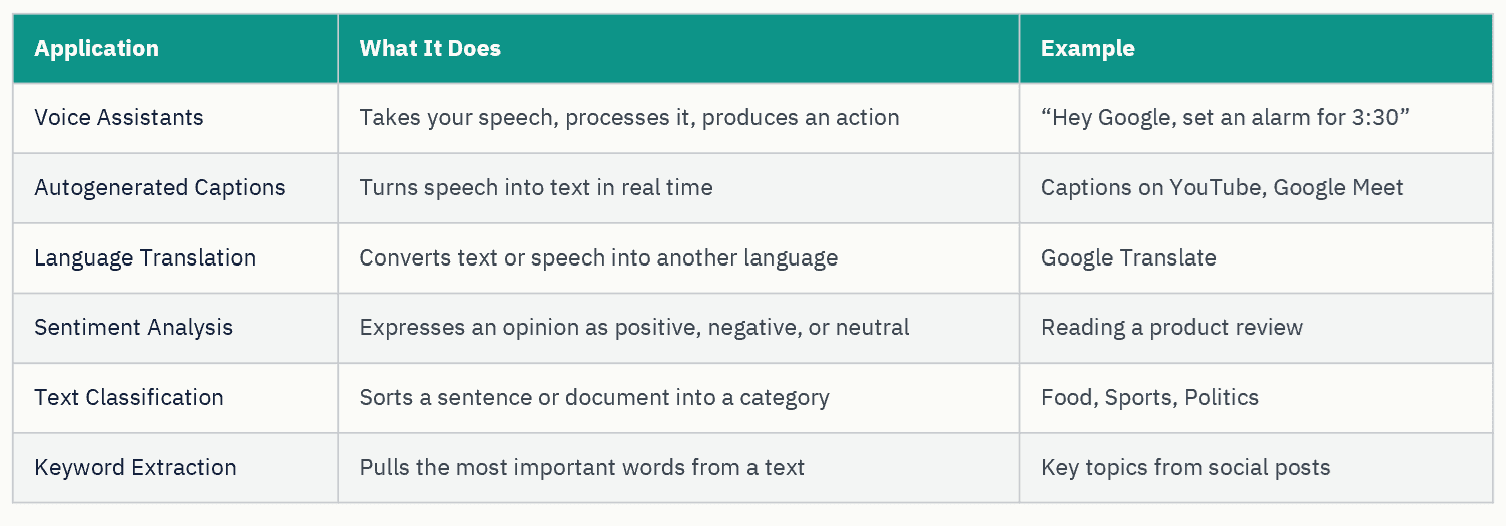
We’ll dig much deeper into Sentiment Analysis, Text Classification, and the machinery behind them in Part 2 of this series.
The Five Stages of NLP
Understanding human language isn’t a single step, it’s a pipeline. NLP breaks the task down into five sequential stages, each solving a different part of the puzzle:

- Lexical Analysis: It identifies the structure of the input words, dividing a large chunk of text into paragraphs, sentences, and words. (“Lexicon” simply means the collection of words and phrases used in a language.)
- Syntactic Analysis (Parsing): It checks the grammar of sentences and phrases, forming relationships among words and eliminating logically incorrect sentences.
- Semantic Analysis: It checks the input text for meaning, verifying that every word and phrase is actually meaningful. (This is the stage that would reject a sentence like “the fox jumped into the dog” which grammatically fine, but nonsensical.)
- Discourse Integration: It forms the story of the text, ensuring each sentence relates sensibly to the sentences before and after it.
- Pragmatic Analysis: It checks sentences for their relevance in the real world. This is where the machine moves past the literal, dictionary meaning of words and works out the intended meaning, the practical, logical sense behind what was actually said.
Each NLP stage hands off a cleaner, better-understood version of the text to the next and this same pipeline, at a much larger scale, is part of what lets a system like ChatGPT respond to you in a way that feels genuinely understood.
Chatbots
One of the most common, most visible applications of NLP is the chatbot, a computer program designed to simulate human conversation through voice commands, text chats, or both. Chatbots can learn over time how to best interact with humans, answer questions, troubleshoot customer problems, qualify sales prospects, and more.
Not all chatbots are built the same way, though. Broadly, there are two types: Script-Bot and Smart-Bot
Script-Bot
A Script-bot is a rule-based chatbot. It relies on a predefined set of questions and corresponding answers, using something like a decision-tree of rules to understand a query and respond. For example, a clothing website’s order-tracking bot might follow a rule like: If the user’s message contains ‘track order’ or ‘delivery,’ show order-tracking options.
- It doesn’t require a massive training dataset.
- It is simple to build, and limited to the scenarios its rules cover.
- The learning is static, once trained, it does not adapt. If a user’s query falls outside its rules, it simply can’t help, and it won’t learn from that failure.
Smart-Bot
A Smart-bot is AI-powered, built on a learning-based approach rather than fixed rules. Instead of being explicitly programmed for every scenario, it learns patterns from data and, crucially, it can adapt and improve as it’s exposed to more data and feedback over time. ChatGPT is a Smart-bot, a large-scale one, which is exactly why it can hold a natural conversation instead of just matching your message against a fixed list of rules.
- It requires more data and training.
- It understands context and natural variation in how people phrase things.
- It keeps improving with use, rather than being frozen at “however it was built.”
The next time you chat with a bot online, see if you can tell which kind you’re talking to? Does it feel like it’s following a strict script, or does it seem to actually understand what you’re asking?
Test Yourself
- Natural Language Processing majorly deals with what kind of data.
- State all stages of Natural Language Processing?
- Give some applications of NLP we use in daily life.
- Mention a few features of natural languages.
- What is the significance of NLP?
- What do you mean by lexical analysis in NLP?
- What do you mean by a chatbot, and how does a Script-bot differ from a Smart-bot?
Stay Tuned!!
Stay tuned for next part of this chapter, where we will deep dive into how does a computer actually turn words into numbers and hands-on with Text Normalization, the Bag of Words model, TF-IDF models and understand Sentiment Analysis.
Click below for the YouTube video for Part 1 of Unit 6:
For any queries and clarification, kindly email us at datasciencehorizon@gmail.com
Keep learning and keep implementing!!

