Most people see what Agentic AI does — but very few understand how it is built. Knowing the architecture is what separates professionals who use AI from professionals who design, deploy, and lead with it.
The 5 Layers of Agentic AI Architecture
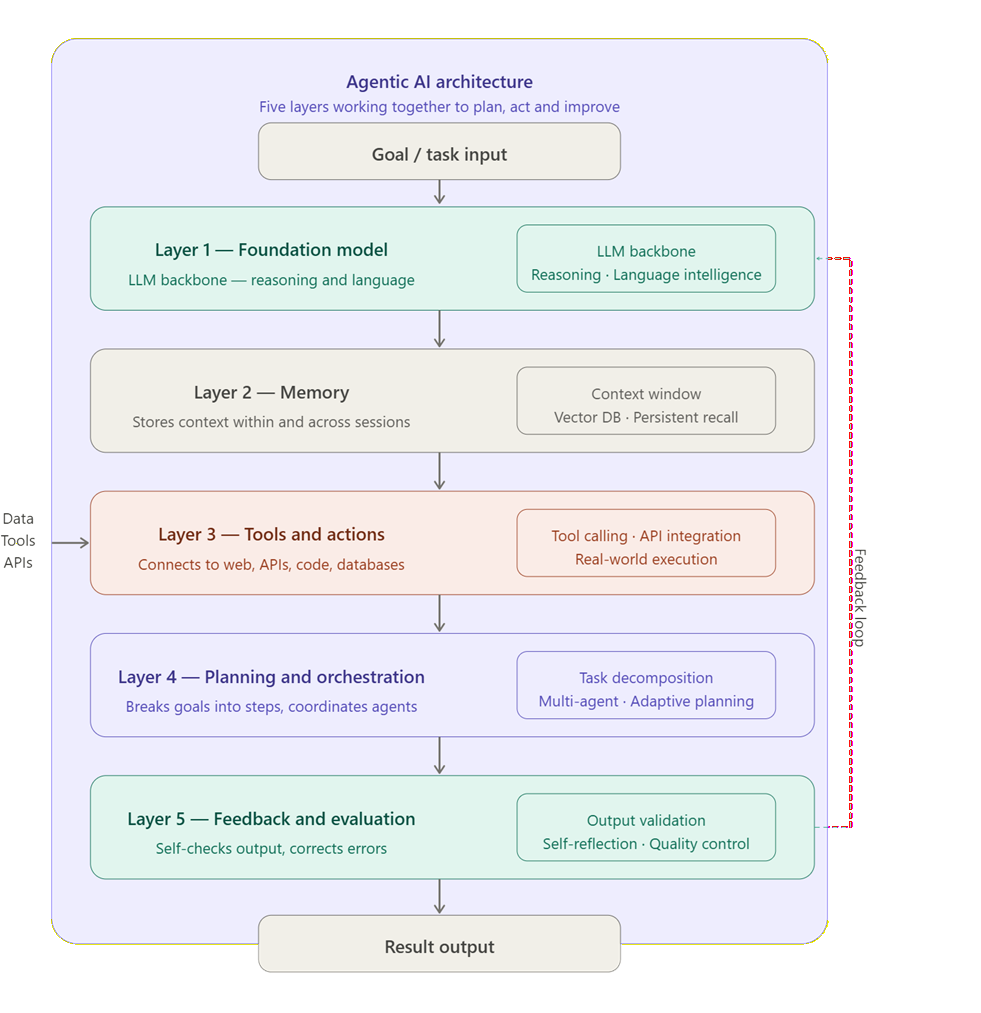
Let’s understand the 5 layers of Agentic AI Architecture:
1. The Foundation Model Layer
At the core sits a large language model — like GPT-4o or Claude — that provides the reasoning, language understanding, and decision-making capability the entire agent depends on.
Focus: LLM backbone, reasoning engine, language intelligence
2. The Memory Layer
This layer gives the agent its ability to remember — storing short-term context within a session and long-term knowledge across sessions, so it builds on what it already knows.
Focus: Context window, vector databases, persistent recall
3. The Tools & Actions Layer
Here, the agent connects to the outside world — web browsers, APIs, code interpreters, databases, and external apps — turning reasoning into real, executable outcomes.
Focus: Tool calling, API integration, real-world execution
4. The Planning & Orchestration Layer
This is the brain of the architecture — where the agent breaks complex goals into subtasks, decides the order of actions, manages multiple agents working in parallel, and adapts when something goes wrong.
Focus: Task decomposition, multi-agent coordination, adaptive planning
5. The Feedback & Evaluation Layer
The agent does not just act — it checks its own work, scores its outputs against the original goal, and self-corrects before returning a final result, making it reliable enough for real business use.
Focus: Output validation, self-reflection, quality control
The organisations building on top of this architecture today are not waiting for AI to mature — they are already deploying autonomous systems that plan, execute, and improve on their own. Understanding the layers is your first step to being part of that.
Stay Tuned!!
Follow @datasciencehorizon for weekly posts on AI architecture, data science, and the tools reshaping how professionals work.
Explore the articles below for the complete implementation of AI Agents.
Building an AI Agent to Detect and Handle Anomalies in Time-Series Data
Keep learning and keep implementing!!