So far in our AI-417 journey, we’ve built AI models, learned how to evaluate them, and dug into the sub-categories of Machine Learning and Deep Learning. Every time, the assumption was the same: you would write the code. But what if you don’t know how to code and you still need an AI model, today, for a real problem?
That’s exactly where Unit 4 begins. In this two-part series, we will step into a world where AI models are built without writing a single line of code. Part 1 covers No-Code AI tools, how it’s different from Low-Code and High-Code development, and where the AI Project Cycle fits when there’s no coding involved. We will also do a real case study on the Titanic Survival dataset on Statistical Data
What Is No-Code AI, and Why Do We Need It?
Traditionally, building an AI model meant writing code to try out different algorithms, testing them, comparing results, and picking the best one. That’s a lot of code, and a lot of room for errors.
“No-Code AI” removes that barrier. You do not need to know how to code to build an AI model. Anyone like a doctor, an architect, a musician, or a Class X student can use these no-code AI tools to build accurate AI models. With a No-Code tool, you simply “drag and drop” pre-built components to build, train, and test an AI model, visually, in a matter of seconds.
Why No-Code AI Matters?
- No coding knowledge required, you can implement complex ML algorithms without writing code.
- Fewer errors, since there’s no code to write, there are no code errors to debug.
- Cost-effective, building a fully coded AI system from scratch is expensive; No-Code AI saves that cost.
- Less staffing pressure, companies can experiment with AI without hiring a dedicated AI development team.
- Easy to use, the drag-and-drop, visual interface means even a middle-school student can build an AI model.
- Transparent because everything is visual, you can see exactly what you’re building, in real time.
In short, No-Code AI makes artificial intelligence accessible to the general public. not just to programmers.
High Code, Low Code, No Code: What’s the Real Difference?
High code if for full-time programmers, low code is for beginners and no-code is for people who have no knowledge of coding but still want to implement AI model. Always remember, the less code you write, the less control and customization you have, but the faster and more accessible the process becomes.
High Code = full control, high effort. No Code = zero coding effort, less control.
Benefits and Disadvantages of No-Code AI Tools
Like any technology choice, No-Code AI is a trade-off. Here’s the balanced picture your exam expects you to know.
Benefits
- Makes AI accessible to non-technical people, doctors, architects, musicians, students. Anyone can build accurate AI models.
- Saves cost, since companies don’t need to build and maintain a fully coded AI system.
- Reduces the need to hire specialized AI staff.
- Visual, real-time feedback makes the building process transparent and easy to learn.
Disadvantages
- Lack of flexibility as drag-and-drop elements are convenient, but you’re limited to the fixed elements the tool provides. You can’t customize beyond what’s built in.
- Automation bias as this is the tendency for humans to blindly trust the suggestions made by an automated system, even ignoring correct information that contradicts it. Because No-Code tools make everything look effortless, users can start over-trusting the output without questioning it.
- Security issues as No-Code platforms don’t always force you to think about security best practices, and they usually offer limited control over sensitive data. They’re best suited to organizations that aren’t handling highly sensitive information.
Popular No-Code AI Tools
Let’s see top 5 popular no-code AI tools used widely with their details and release information.
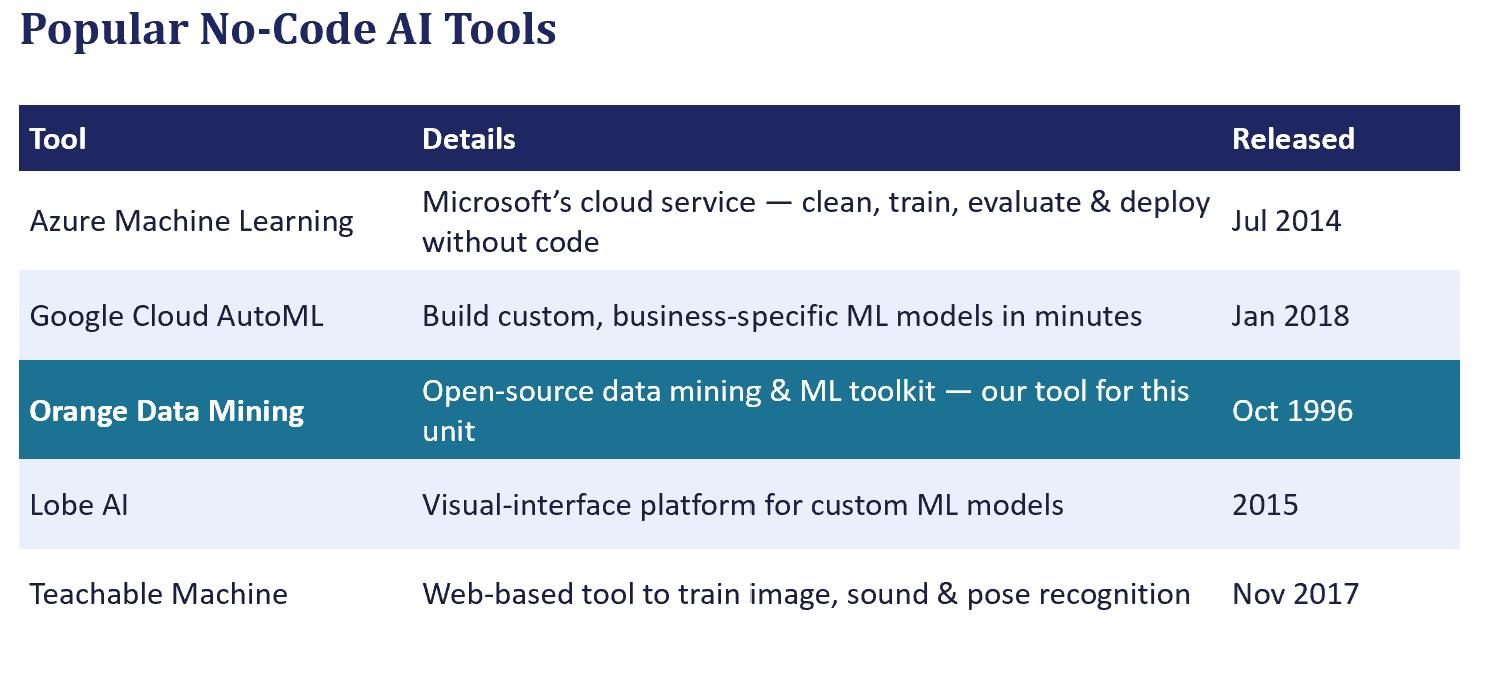
Out of all these, Orange Data Mining (ODM) is the tool we’ll use throughout this unit. We will build model on Titanic Data set in this part of the chapter together and implement sentiment analysis in Part 2 or Unit 4 using Orange Data Mining Tool.
How Does the AI Project Cycle Change for No-Code AI?
Recall the six stages of the AI Project Cycle: Problem Scoping, Data Acquisition, Data Exploration, Modelling, Evaluation, and Deployment.
Here’s the good news : the AI Project Cycle doesn’t change when you move to a No-Code tool. But, every stage still applies.
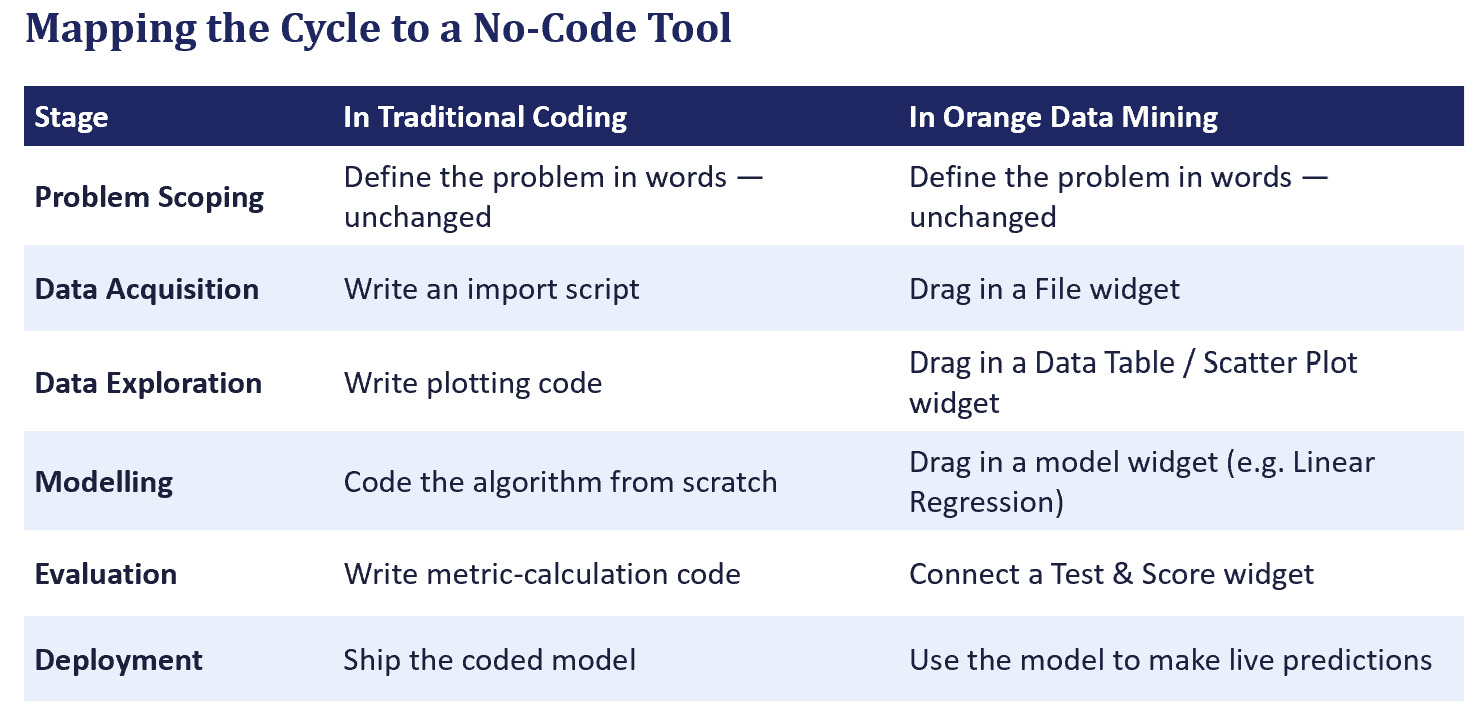 What changes is how you execute each stage not what the stages are. Every stage of the AI Project Cycle can be mapped directly onto Orange Data Mining’s widgets, simply by connecting them visually on a canvas instead of writing functions in code.
Download Orange Data Mining Tool
Click on the above link to download Orange Data Mining Tool and install it before heading further for Titanic Survival Case Study.
Titanic Survival Case-Study
Titanic Dataset: https://www.kaggle.com/competitions/titanic/data
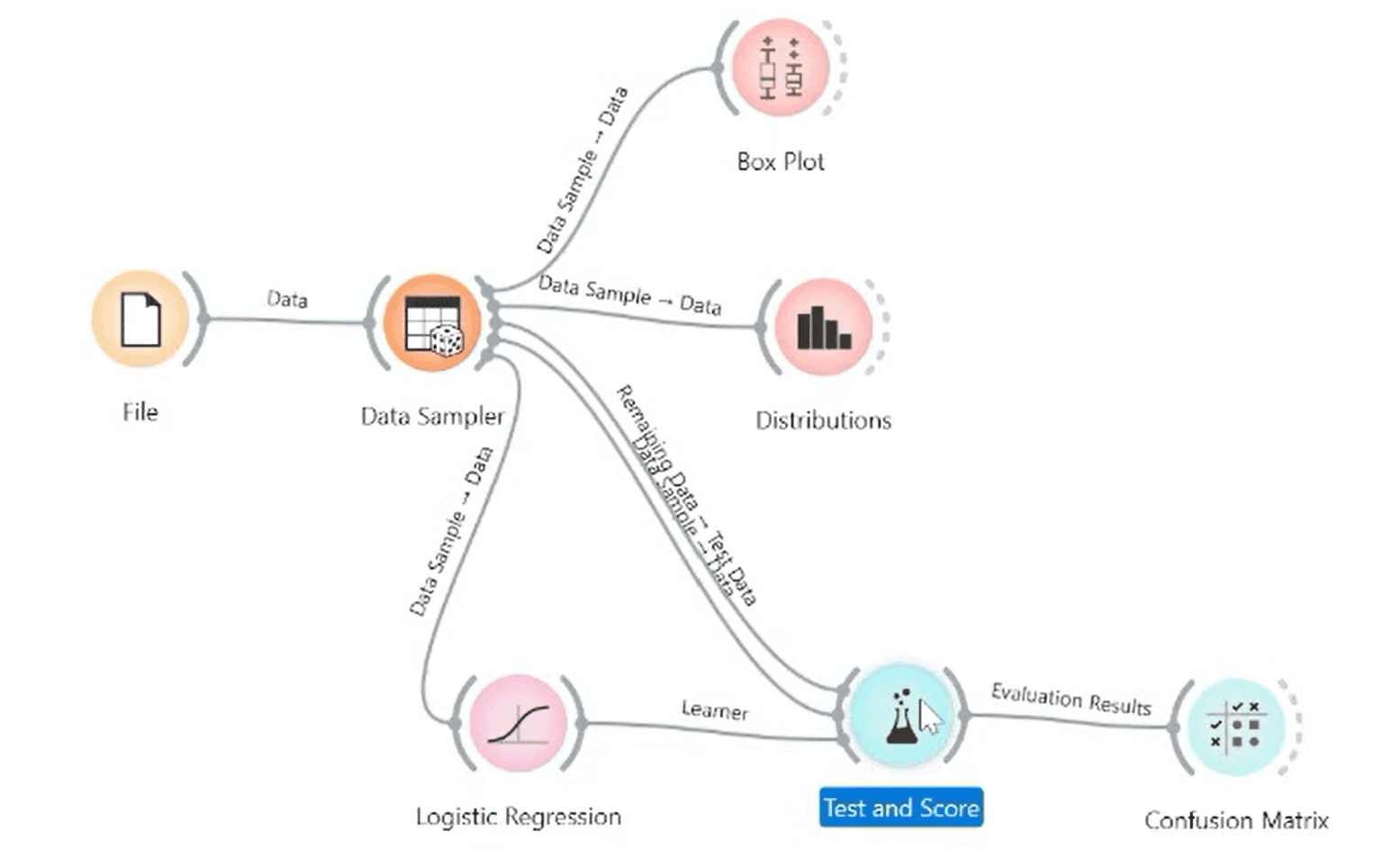
I have implemented all steps: File → Data Sampler → Distribution Plot/Box Plot → Classification model → Test & Score → Confusion Matrix using Orange Data Mining Tool as shown in the image below. I have shown all modeling steps and evaluation metrices in the you tube video in detail.
Click here for the video.
Stay Tuned!!
Stay tuned for next chapter, where we give live demo for Sentiment Analysis(NLP) using Orange Data Mining Tool.
Click below for the YouTube video for Part 1 of Unit 4:
For any queries and clarification, kindly email us at datasciencehorizon@gmail.com
Keep learning and keep implementing!!