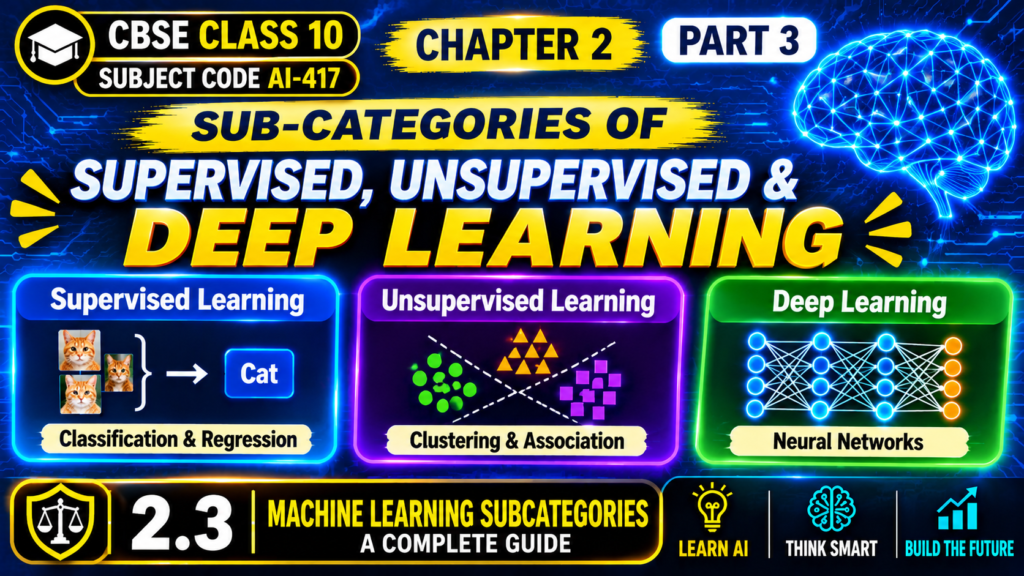
In this article we will breakdown 2.3 Sub-Categories of Machine Learning and Deep Learning of Unit 2: Advanced Concepts of Modelling in AI (AI Course; Class 10)
In our previous articles on Unit 2, we revisited the difference between AI, ML, and DL, and learned that Machine Learning models are broadly divided into three types: Supervised Learning, Unsupervised Learning, and Reinforcement Learning. Links are as below:
2.2 Modelling: Rule-Based vs. Learning-Based Approaches (AI Course Class 10)
Sub-Categories of Supervised Learning Model
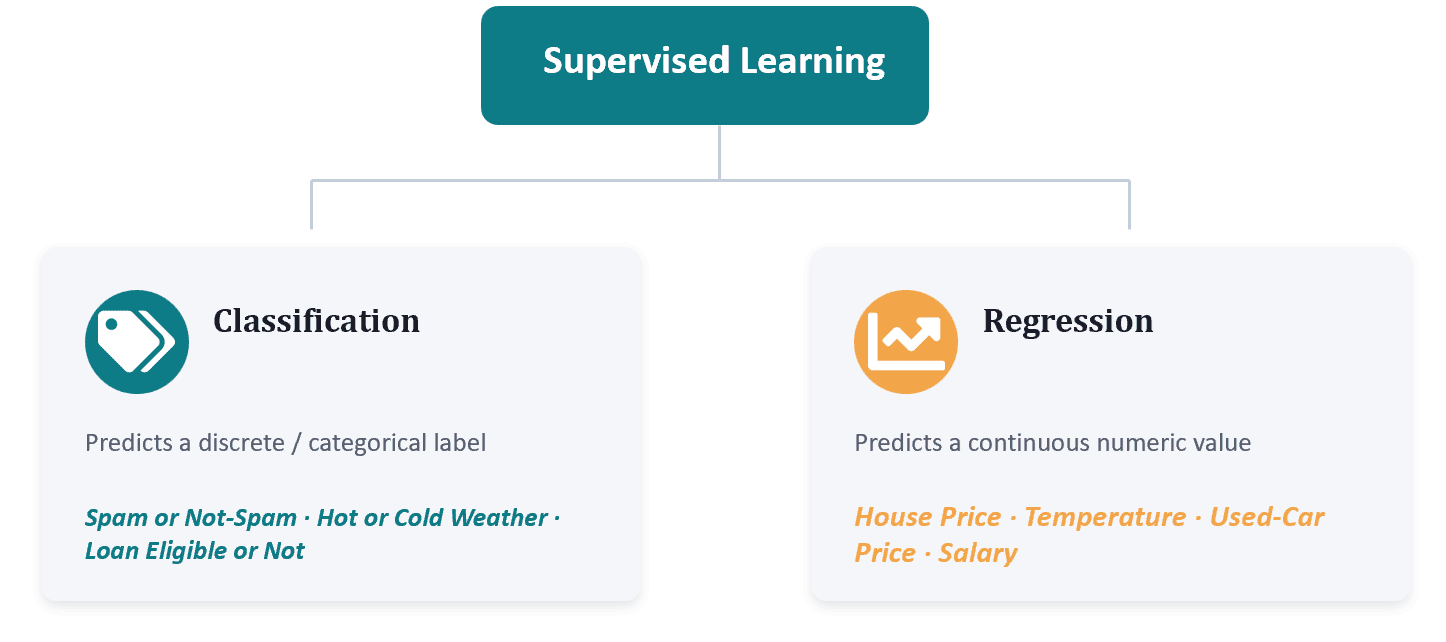
Recall that in Supervised Learning, the machine is trained on “labeled data“, similar to a math teacher who teaches through solved examples (training) and then tests students on new problems. Supervised Learning has two types of models: Classification and Regression.
Classification
In a Classification model, data is classified according to labels, and this model works on a discrete dataset (to learn more about different types of categorical data, click here), meaning the data need not be continuous. Just like students are classified into grades (A, B, C) based on the marks they score in an exam, a classification model assigns a fixed category to every input.
Example: Weather Prediction
A model can be trained on historical weather data that includes temperature information labeled as “hot” or “cold.” The model learns patterns based on features like:
- Location (average temperatures vary geographically)
- Season (summer vs. winter)
- High and low temperatures
- Humidity
When presented with tomorrow’s weather data, the trained model analyzes these factors and predicts the most likely category as “hot” or “cold.”
Example 2: Classifying Emails as Spam or Not
The model is shown a large number of emails both real ones (from friends or colleagues) and spam. It learns what makes an email look like spam. Once trained, when a new email arrives, the model analyzes it and decides, if this email is spam or not? In modern email systems, this idea has evolved further into categories like social, promotions, and updates.
Regression
Regression models work on continuous data. If you wanted to predict your next salary, you would feed in data about your previous salary, increments, and so on, this is continuous data, and the model would be a regression model. Regression algorithms predict a continuous value based on input variables such as Temperature, Price, Income, or Age.
Example: Predicting Temperature
Temperature is a continuous variable, it can take on any value within a range. So, regression models are well-suited to predict it.
Example: Predicting the Price of a House
Suppose we want to predict a house’s price based on features called as independent variables such as:
- Number of bedrooms
- Carpet size
- Garage area
Here, price is the label (dependent variable).
Example 3: Used Car Price Prediction
A model can predict the selling price of a used car using parameters like fuel type, years of service, number of previous owners, kilometers driven, and transmission type. Since the model predicts an approximate price, a continuous value, this is a regression problem.
Quick Note: Predicting whether a customer is eligible for a bank loan or not is Classification(a Yes/No, discrete output), while predicting the weather for the next 24 hours is Regression(a continuously changing value).
Sub-Categories of Unsupervised Learning Model
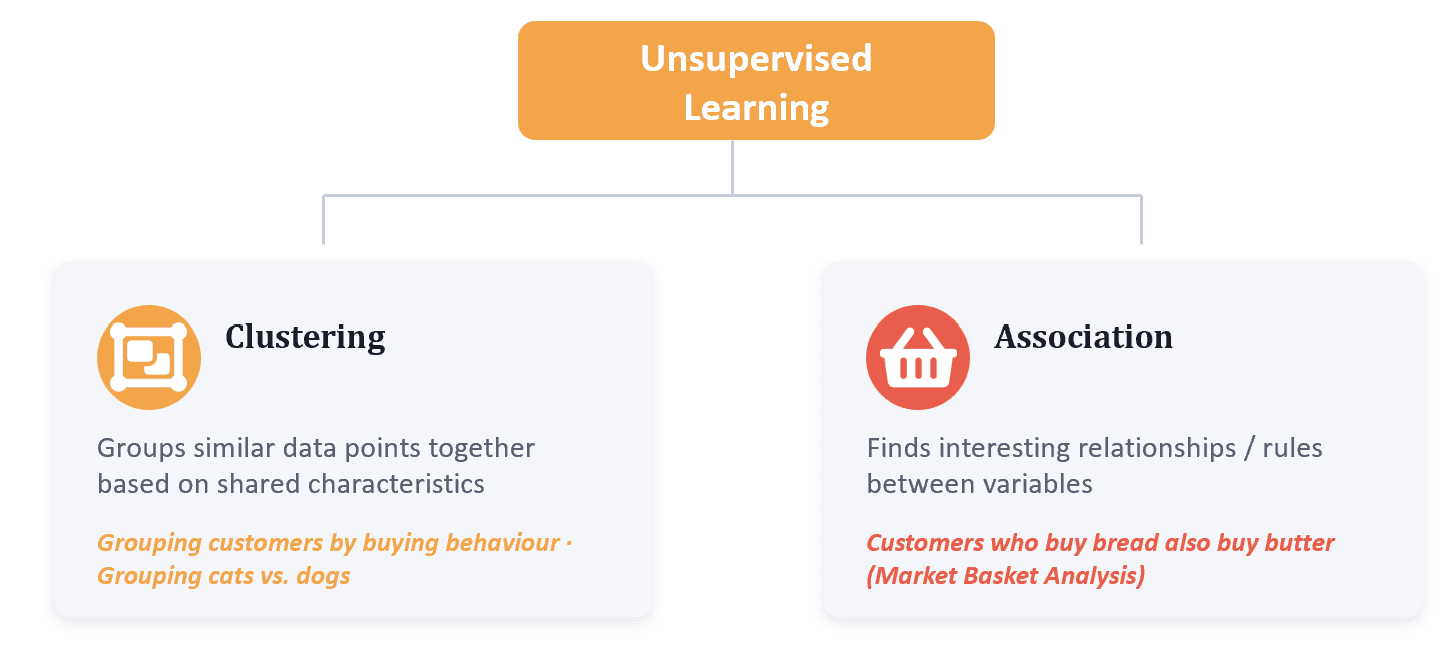
Unlike Supervised Learning, Unsupervised Learning works on unlabeled data, like a child learning to swim on their own, without any supervision. The machine has to discover patterns, similarities, and differences purely on its own. Unsupervised Learning also has two sub-categories: Clustering and Association.
Clustering
Clustering models identify relationships, patterns, and trends within data that has no predefined labels. It’s important to understand the difference between Classification and Clustering:
- Classification uses predefined classes or labels in which objects are assigned.
- Clustering finds similarities between objects and places them into the same cluster, easily differentiable from objects in other clusters.
Example: Music Preferences
Jim enjoys listening to music with a slow tempo and soft intensity, but dislikes songs with a fast tempo and high intensity. If we group all his liked songs into one cluster and disliked songs into another, purely based on tempo and intensity, without ever labeling songs as “like” or “dislike” in advance, that’s clustering at work. If a new song with a slow tempo and soft intensity comes along, we can now predict which cluster it belongs to. This is exactly how platforms like Netflix and Spotify power their recommendations system.
Example: Grouping Animal Images
Give an unsupervised model a set of unlabeled images containing cats and dogs. Even without any labels, the model can identify similarities in visual features and group all the cats into one cluster and all the dogs into another.
Association
Association Rule is an unsupervised learning method used to find interesting relationships between variables in a database.
Example: Market Basket Analysis
Based on the purchase patterns of many customers, if we notice that customers who buy bread also tend to buy butter, we can predict that a new customer, Customer X, who buys bread is highly likely to also buy butter. Such meaningful associations are extremely useful for recommending items to customers, this is called the Association Rule. It’s the logic behind “customers who bought this also bought that…” suggestions on e-commerce sites.
Sub-Categories of Deep Learning
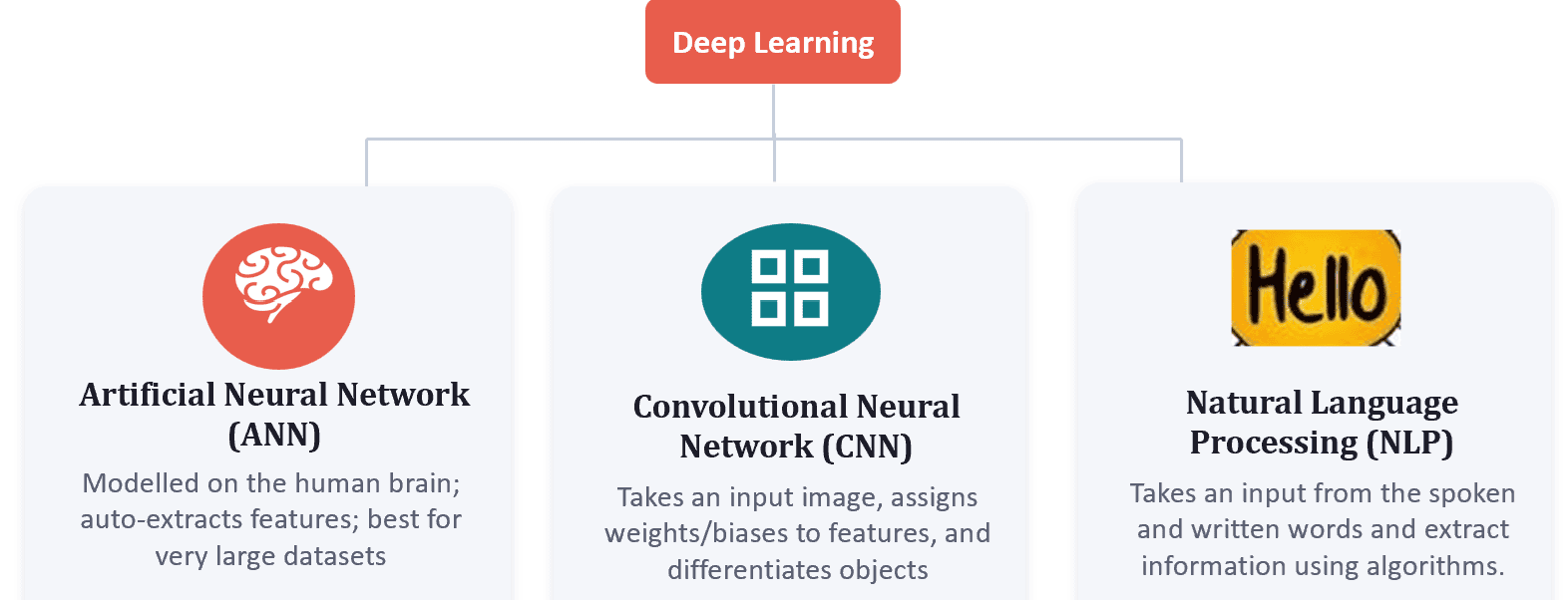
We know that Deep Learning enables software to train itself to perform tasks using vast amounts of data. The machine becomes intelligent enough to develop algorithms for itself. There are three types of Deep Learning models:
- Artificial Neural Networks (ANN)
- Convolutional Neural Networks (CNN)
- Natural Language Processing (NLP)
Artificial Neural Networks (ANN)
Artificial Neural Networks are modelled on the human brain and nervous system. They are able to automatically extract features without any input from the programmer. Every node in the neural network essentially behaves like its own machine learning algorithm. ANNs are especially useful for solving problems where the dataset is very large.
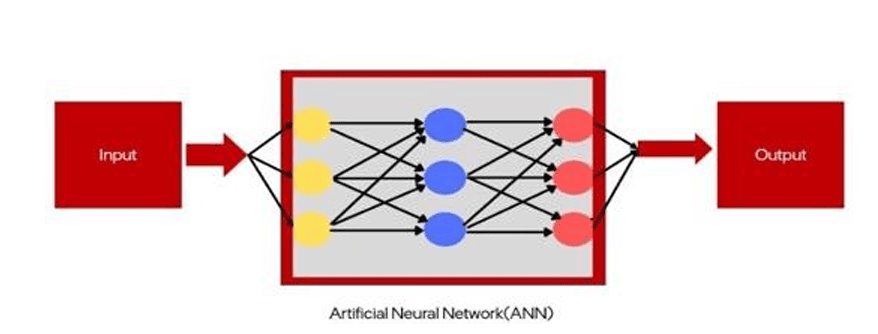
The structure of a neural network consists of:
- Input Layer: acquires data and feeds it into the network; no processing happens here.
- Hidden Layer(s): where the actual computation happens, using weights and biases on each node.
- Output Layer: delivers the final, processed result to the user.
We will learn Neural Network in detail in next part of this chapter.
Real-world applications of ANN include facial recognition, customer-support chatbots, and price prediction.
Convolutional Neural Networks (CNN)
A Convolutional Neural Network is a Deep Learning algorithm that can take an input image, assign importance (learnable weights and biases) to various aspects or objects within the image, and differentiate one object from another.
Click here, to learn CNN in detail.
Natural Language Processing (NLP)
NLP is a deep learning algorithm that takes an input from the spoken and written words and extract information from it using algorithms.
Click here, to learn NLP in detail.
Think this way: ANN is the generalist modelled on the whole brain and best suited to very large, general datasets. CNN is the specialist built for image and visual data, think face recognition, object detection, and medical imaging. NLP is also the specialist built for textual data, think of voice assistants, sentiment analysis, and text classification.
Lets’ Summarize
| Sub-Category | Belongs To | What It Does? |
| Classification | Supervised Learning | Classifies data into discrete categories |
| Regression | Supervised Learning | Predicts a continuous numeric output |
| Clustering | Unsupervised Learning | Groups similar, unlabelled data points |
| Association | Unsupervised Learning | Finds relationships between variables |
| Artificial Neural Network (ANN) | Deep Learning | General-purpose, brain-inspired network for large datasets |
| Computer Vision (CV) | Deep Learning | Specialized network for image and visual data |
| Natural Language Processing (NLP) | Deep Learning | Specialized network for textual data |
Test Yourself
- Predicting whether a bank loan applicant will “default” or “non-default” is an example of which model?
- A marketing company segments its customers into groups based on purchasing behavior, with no predefined categories. Which type of learning is this?
- A grocery store wants to know which products are commonly bought together. Which unsupervised model does this describe?
- Which Deep Learning model would you choose for a self-driving car’s object-detection system, and why?
Stay Tuned!!
Stay tuned for Part 4 of this unit, where we cover Artificial Neural Network in a simplified and practical manner.
Click below for the YouTube video for Part 3 of Unit 2:
For any queries and clarification, kindly email us at datasciencehorizon@gmail.com
Keep learning and keep implementing!!