In this tutorial, we will cover subunit 2.1 Revisiting AI, ML, DL of Unit 2: Advanced Concepts of Modeling in AI of the Artificial Intelligence course (AI-417) for Class 10.
For Unit 1: Ethical Frameworks for AI and Bioethics, click on the link below:
Part 1: https://datasciencehorizon.com/1-1-ai-project-cycle-introduction-to-ai-domains/
Part 2: https://datasciencehorizon.com/ethical-frameworks-for-ai-and-bioethics-ai-course-class-10/
Revisiting AI, ML, DL
To build an AI-based project, we need to work with artificially intelligent models or algorithms, either by designing our own or using pre-existing ones. Before jumping into modelling, let’s understand Artificial Intelligence (AI), Machine Learning (ML), and Deep Learning (DL).
Differentiating Between AI, ML, and DL
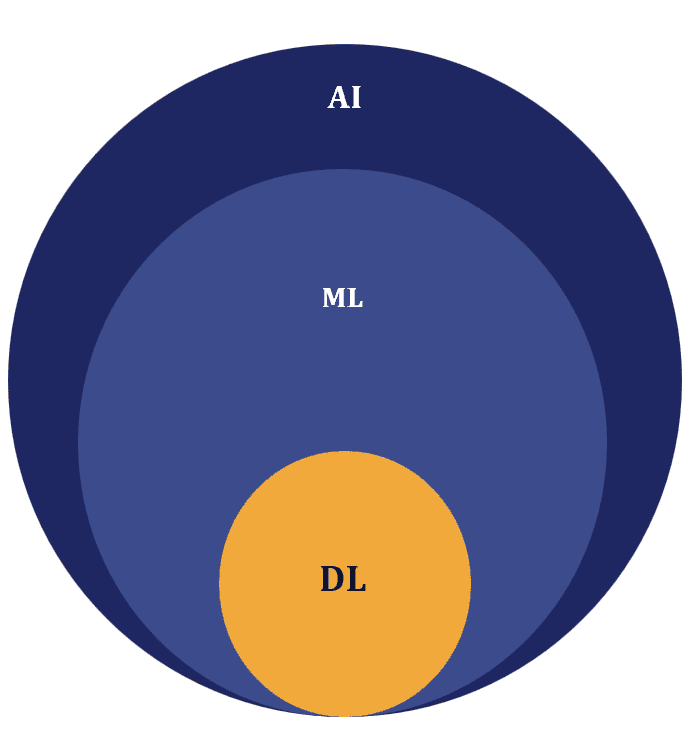
Artificial Intelligence is the umbrella term that covers both Machine Learning and Deep Learning. Deep Learning itself falls under Machine Learning, think of it as a nested Venn diagram as shown in image below. There are many applications of AI, a smaller number of which use ML, and an even smaller, more specialized number of which use DL.
Artificial Intelligence (AI)
AI refers to any technique that enables computers to mimic human intelligence. An artificially intelligent machine works on algorithms and data fed to it, and gives the desired output.
Machine Learning (ML)
ML enables machines to improve at tasks with experience. The machine learns from new data fed to it during testing and uses that learning for the next iteration. Machine Learning enables machines to improve at tasks with experience. The machine learns from its mistakes and takes them into consideration in the next execution. It improvises itself using its own experience.
In a ML model, Input (past or historical data) is given, and the model generates output by learning from the input data. Example: Labelled images each tagged as either “apple” or “strawberry” are given as input to the ML model. The model learns from this input data to classify between apples and strawberries and predicts the correct output as shown in image below.
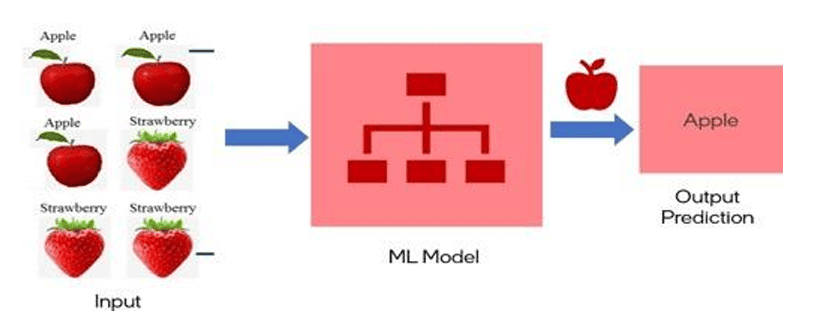
Examples of Machine Learning
- Object Classification which identifies and labels objects present within an image or data point; determines the category an object belongs to.
- Anomaly Detection which helps us find unexpected things hiding in our data. For example, tracking your heart rate and finding a sudden spike could be an anomaly, flagging a potential issue.
Deep Learning (DL)
DL enables software to train itself to perform tasks using vast amounts of data. Since the system has such a huge dataset, it’s able to train itself with the help of multiple machine learning algorithms working together to perform a specific task.
Deep Learning enables software to train itself to perform tasks using vast amounts of data. In deep learning, the machine is trained with huge amounts of data, which helps it train itself using multiple Machine Learning algorithms around that data. Such machines are intelligent enough to develop algorithms for themselves. Deep Learning is the most advanced form of Artificial Intelligence out of these three.
Input is given to an Artificial Neural Network (ANN), and after processing, the output is generated by the DL block. Example: Pixels of a bird image are given as input to the DL model, and the model is able to analyze and correctly predict that it is a bird using a deep learning algorithm (ANN) as shown in image below.
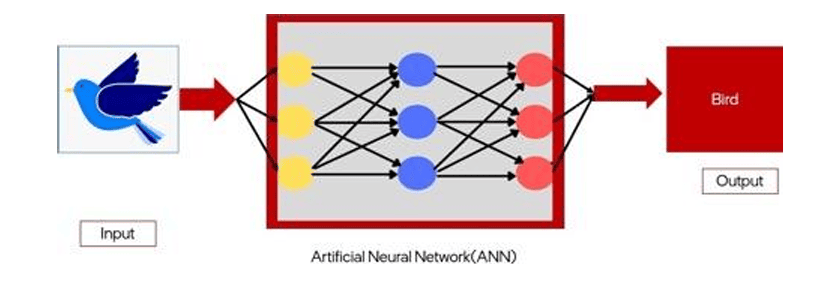
Examples of Deep Learning
- Object Identification uses powerful algorithms to figure out what’s in a picture and categorize the objects within it.
- Digit Recognition tackles the challenge of training computers to identify handwritten digits (0–9) within images.
Common Terminologies Used with Data
Let’s understand data and its common terminologies:
What is Data?
- Data is information in any form.
- For example, an excel sheet or table with information about fruits is data.
- Each row contains information about a different fruit.
- Each fruit is described by certain features, as shown in below image.
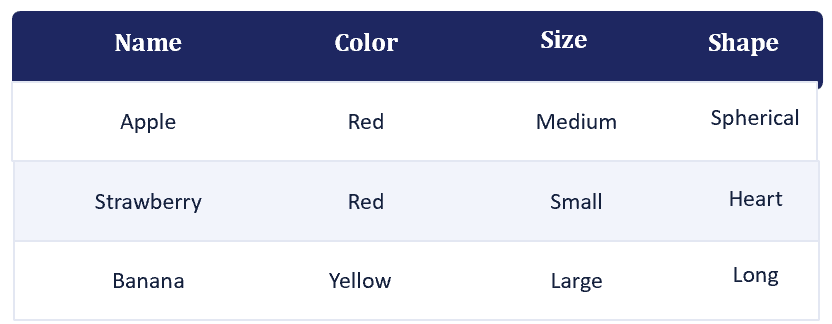
Define Features?
- Columns of the table are called features.
- In the fruit dataset example, features may be color, shape, size, etc.
- Some features are special and they are called labels.
Define Labels
Data labeling is the process of attaching meaning to data. It depends on the context of the problem we’re trying to solve.
For example, if we’re trying to predict what fruit it is based on the color, shape and size of the fruit, then color, shape and size are the features, and the fruit name is the label.
Types of Data
Data can be of two types: Labeled and Unlabeled:
- Labeled Data is data to which some tag/label is attached (e.g., name, type, number).
- Unlabeled Data is the raw form of data; data to which no tag/label is attached.
What Do You Mean by a Training Data Set?
- The training data set is a collection of examples given to the model to analyze and learn.
- Just like a teacher teaches a topic to the class through lots of examples and illustrations.
- Similarly, a set of labeled data is used to train the AI model.
What Do You Mean by a Testing Data Set?
- The testing data set is used to test the accuracy of the model.
- Just like a teacher takes a class test related to a topic to evaluate the understanding level of students.
- The test is performed without labeled data, and then the results are verified with the labels.
Test Yourself
- What is the relationship between AI, ML, and DL?
- Which of the three AI, ML, or DL is described as “the most advanced form of Artificial Intelligence”?
- In a fruit dataset used to predict fruit type from color, which is the feature and which is the label?
- What is the difference between labeled and unlabeled data?
- Why is a testing dataset performed without labels first, before verifying with labels?
- Give one real-world example each of Machine Learning and Deep Learning that you encounter in daily life.
Stay Tuned!!
Stay tuned for Part 2 of this unit, where we cover rule-based vs. learning-based models, and supervised, unsupervised, and reinforcement learning in a simplified and practical manner.
Click below for the YouTube video for Part 1 of Unit 2:
For any queries and clarification, kindly email us at datasciencehorizon@gmail.com
Keep learning and keep implementing!!