1.2 Ethical Frameworks for AI and Bioethics
In this tutorial, we will cover Ethical Frameworks for AI and Bioethics from Unit 1: Revisiting AI Project Cycle and Ethical Frameworks for AI of the AI-417 course for Class 10.
For Subunit 1.1 AI Project Cycle and Introduction to AI Domains, click on the link below:
https://datasciencehorizon.com/1-1-ai-project-cycle-introduction-to-ai-domains/
Ethical Frameworks for AI
Let’s discuss Ethical Frameworks for AI.
What are Frameworks?
Think of a framework as a checklist for handling something complicated without missing a step. It doesn’t hand you the answer; it gives you an order of operations, so you approach whatever problem you throw at it the same reliable way every time. A good framework also means two people solving the same problem talk about it in the same terms, instead of reinventing their own approach from scratch.
You’ve already used one this unit without calling it a Framework.
The AI Project Cycle from Part 1 is exactly a framework: a fixed sequence of stages you follow whenever you build an AI project, whatever the project actually is.
What are Ethical Frameworks?
Ethics, put simply, is your internal compass for right and wrong. Put ethics inside a framework, and you get something you can actually apply consistently:
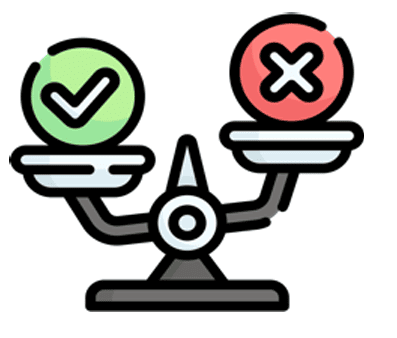
An ethical framework is a structured way of judging whether an AI system’s decision doesn’t quietly cause harm that nobody intended.
Rather than relying on gut feeling case by case, an ethical framework forces you to weigh the same set of principles every time, so an organisation’s decisions stay consistent and defensible, not just convenient.
Why Do We Need Ethical Frameworks for AI?
Here’s the uncomfortable part: an AI system doesn’t automatically know right from wrong. It only knows patterns in whatever data it was trained on, and it repeats those patterns at scale. A well-documented real case: some early facial-recognition systems performed noticeably worse at identifying people with darker skin tones, simply because their training photos skewed toward lighter-skinned faces. Nobody had to intend that outcome for it to happen; it fell out of an unbalanced dataset.
That’s exactly why ethical frameworks matter for AI specifically. AI increasingly makes or influences real decisions about who gets shortlisted for a scholarship, what content a teenager sees next, and which loan application gets flagged for review. Building the ethical check into the system from day one catches problems like the one above before deployment, instead of after real people have already been affected.
Types of Ethical Frameworks
Ethical frameworks for AI generally fall into two broad types.
1. Sector-based Frameworks
These are built for one specific industry, because different fields run into very different ethical stakes. In AI, the best-known sector-based framework is “Bioethics” built for healthcare, where an AI mistake can affect someone’s health or life directly. The same idea applies elsewhere too: a self-driving car company needs a transportation-specific framework (who’s responsible in a crash?), and a bank rolling out AI loan approval needs a finance-specific one.
2. Value-based Frameworks
Instead of being tied to one industry, these frameworks are built around a core moral principle and applied wherever AI shows up. They split into three flavors:
| Type | What it prioritizes | An AI example |
| Rights-based | Individual dignity and rights come first, above almost any other consideration. | A school’s exam-proctoring AI must not flag a student as “suspicious” just because of their skin tone, disability, or background. |
| Virtue-based | The choice that creates the greatest overall benefit for the greatest number of people, even if it isn’t perfect for everyone | A city’s traffic-signal AI optimizes overall commute time for the whole city, even if a few individual routes get slightly longer |
| Utility-based | Whether the people building and running the system are acting with honesty, care, and integrity or not, not only just following rules | A social media company choosing to *dial down* an engagement algorithm known to push teenagers toward harmful content, even though it would cost them ad revenue |
Together, these give you two independent questions to ask about any AI system:
- What industry-specific risks does it carry?
- Which core value should win when trade-offs show up?
Think about these questions and try to answer in different scenarios.
Bioethics
Let’s look at the sector-based framework built specifically for health and medicine.
Bioethics is the ethical framework used across healthcare and life sciences. It exists to make sure that decisions involving a person’s health, body, or medical data are held to a higher standard than it technically worked.
The Four Principles of Bioethics
The four principles of Bioethics are:
1. Respect for Autonomy
People have a right to understand how a decision about their health was reached, not just be told the outcome.
2. Non-maleficence
First, do no harm; where harm can’t be fully avoided, choose whichever path causes the least of it.
3. Beneficence
Go beyond “not harmful” and actively aim to improve the person’s or community’s well-being.
4. Justice
The benefits and the risks of a healthcare decision should be shared fairly, not concentrated on or dumped onto any one group.
Case Study: The AI Symptom-Checker App
A health-tech startup builds a free AI chatbot that lets anyone describe their symptoms in a few sentences and get a quick read on how urgently they should see a doctor, useful for people in areas with few nearby clinics.
The Problem
During a pilot, the app performed excellently for users typing in polished English, mostly from cities, but for users from smaller towns, describing symptoms in simpler language or mixing in regional terms, it consistently rated genuinely serious symptoms as “low urgency,” delaying care for exactly the users who could least afford the delay.
Why it happened?
The training data was collected almost entirely from urban hospital records and English-language health forums, so the model never learned to recognize how the same condition gets described by someone speaking differently. It wasn’t the symptoms that confused the model, it was the words or language used to describe them.
How Bioethics’ four principles could have caught this earlier
- Autonomy: Every user should be able to see why the app rated their case “low urgency” and it should give a visible reason, invites someone to double-check it, rather than silently trusting a wrong result.
- Non-maleficence: Before launch, the team should have specifically tested accuracy across different regions and language styles, not just an overall average, which can hide a group doing much worse.
- Beneficence: The app’s whole goal was to help people reach care faster. A version that only achieves that for one demographic has quietly abandoned its own purpose for everyone else.
- Justice: Fixing this meant deliberately collecting more training examples from rural clinics and regional-language health queries. The burden of teaching the model shouldn’t fall only on the users it already serves well.
This is the real value of a framework like Bioethics. Only model is 94% accurate doesn’t work for real -life scenarios. Ask simple question:
Accurate for whom, exactly?
Test Yourself
1. If an AI system is being ethically evaluated purely because it operates in healthcare, which type of ethical framework is being applied: sector-based or value-based?
2. A company chooses to act with honesty and integrity even when a shortcut would be more profitable. Which value-based framework best describes this priority?
3. Which value-based framework would most directly object to an AI system that discriminates against a protected group, even if the system is otherwise highly accurate?
4. Bioethics was originally built for which domain, and why does that domain need a dedicated ethical framework?
5. Why can’t we simply trust an AI system to “know” right from wrong on its own?
6. Give one real-world sector, other than healthcare, that you think needs its own sector-based ethical framework, and explain why.
7. Assertion: An ethical framework helps an organization make consistent decisions over time.
Reasoning: A framework replaces the need to think about ethics case-by-case, since it always produces the same answer regardless of context. Are both statements true, and does the reasoning correctly explain the assertion?
Case-Based Question to Discuss
A short-video app popular with teenagers uses an AI recommendation engine designed purely to maximize watch time. Over months, the algorithm learns that slightly sensational, anxiety-inducing content keeps users scrolling longer than calm, educational content, so it quietly starts recommending more of the former. The company isn’t breaking any law, and watch-time directly drives its ad revenue. Parents and child-psychologists have started raising concerns about teenagers’ screen time and mood after using the app.
Question: Using the three value-based frameworks: rights-based, utility-based, and virtue-based, analyze this situation from each lens. Do the three frameworks agree on what the company should do next, or do they pull in different directions? Explain your reasoning.
Stay Tuned!!
Stay tuned for Artificial Intelligence Class 10 content in a simplified and practical manner. For any queries and clarifications, kindly email us at datasciencehorizon@gmail.com
Click below for the YouTube video for 1.2 Ethical Frameworks for AI and Bioethics:
Keep learning and keep implementing!!