
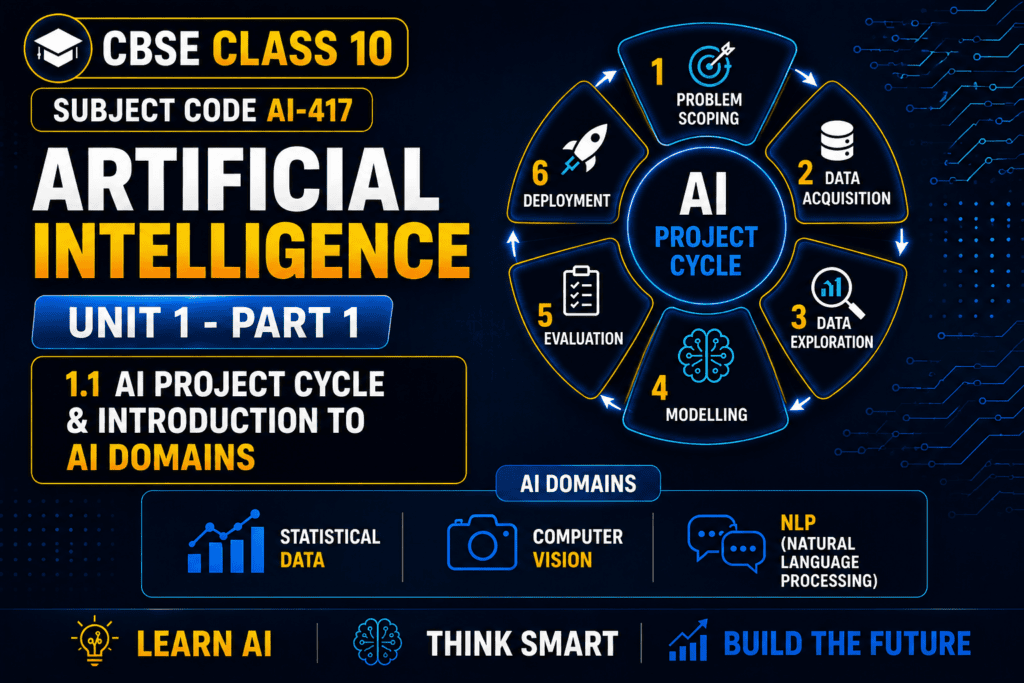
1.1 AI Project Cycle & Introduction to AI Domains
In this tutorial, we will cover the AI Project Cycle and an introduction to the AI Domains of Unit 1: Revisiting the AI Project Cycle and Ethical Frameworks for AI in the AI-417 course for Class 10.
If you were with us for Class 9, you’ve already met the AI Project Cycle and its three domains. Click the link below to review it again.
AI Reflection, Project Cycle and Ethics – Class 9 | AI-417 Unit 1 CBSE
For 1.2 Ethical Frameworks for AI and Bioethics, click on the link below:
1.2 Ethical Frameworks for AI and Bioethics
AI Project Cycle
Let’s assume your exams are approaching, and you are at your study table, preparing for them. Here are some of the steps you might take:
- You check your exam date sheet and decide which subject you are going to prepare for.
- You check out the syllabus of the exam and make a list of materials required to prepare for the exam.
- Now, you will gather all materials in hard and soft copies: books, notes, practice sheets, past year question papers, and their solutions.
- Once you have everything, start preparing for the exam by understanding, learning, and grasping the concepts.
- Once you have prepared, you will start with written practice, attempting practice question papers. Then, you will verify your answers and rectify and relearn the topics needed.
- After preparing properly, you will attempt the exam.
Like the above example, we plan and execute every task like this in various steps, either consciously or unconsciously. Similarly, while developing an AI project, we follow an AI project cycle with a suitable structure that guides us toward our objective when we construct an AI project.
6 Stages of AI Project Cycle
The AI Project Cycle is the cyclical process followed to complete an AI project, and it mainly has 6 stages:
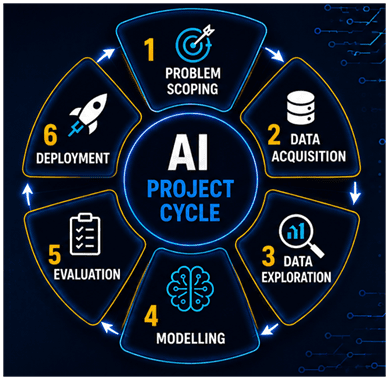
1. Problem Scoping
The first step is to define the goal for your AI project and understand the scope of the problem that you want to solve with the help of AI. We look at the various parameters of the problem to draw a bigger picture easily.
2. Data Acquisition
Here, we collect data from various reliable and authentic sources. This data is the basis of our AI project and helps in understanding the parameters of the AI problem.
3. Data Exploration
Since the data we collect is in large quantities, we will explore the data in various visual forms like graphs and plots, to interpret the patterns and preprocess the data to get it ready for data modeling.
4. Modelling
After exploring the patterns, we decide to look at various Machine learning algorithms, see what suits your needs best, and implement it for modelling.
5. Evaluation
Once modelling is complete, we test our model on newly fetched data that is unseen by the model. The results help you evaluate your model using various performance metrics and improve the performance of the model.
6. Deployment
Finally, after evaluation, deployment is crucial to ensure the successful integration and operation of AI solutions in real-world environments. Only after deployment can it deliver value and impact to users and stakeholders.
Try it yourself
Grab a notebook. In 60 seconds, write your own 6-stage plan for the subject you want to learn and prepare for the exam.
Introduction to AI Domains
Artificial Intelligence becomes intelligent via model training using machine learning algorithms on data related to AI applications. With respect to the type of data fed into the AI model, AI models can be broadly categorized into three domains.
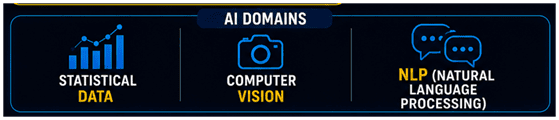
1. Statistical Data
This domain of AI works with numbers: collecting, organising, and analysing structured data such as scores, prices, ratings, or measurements, and uses the patterns hidden in that data to answer questions or predict outcomes. Instead of “seeing” or “reading” anything, the system is doing math across huge volumes of data points to find something useful.
Example: Delivery-Time Estimates
When you order food on an app like Swiggy or Zomato, it shows you an estimated delivery time before you’ve even placed the order. That number comes from statistical analysis of thousands of past delivery data points like distance, time of day, restaurant preparation time, and traffic patterns, not from anyone actually checking the road right now.
Try it yourself
Open Google Trends (trends.google.com) in a browser. Search for two things you’re curious about, like two cricket teams, two movies, or two subjects like “Maths” and “AI,” and compare them while looking at the graph it draws. That entire graph is statistical data: millions of search queries, quietly counted and compared, turned into a line you can read in five seconds.
2. Computer Vision
Computer Vision (CV) gives a machine the ability to look at an image or video and make sense of what’s in it, like identifying objects, faces, text, or patterns and then act on that understanding. The machine doesn’t see the way we do; it processes an image pixel by pixel, hunting for shapes, edges, and patterns it has learned to recognise.
Examples: Face Unlock
When you unlock your phone by holding it up to your face, the camera captures your face, and a computer vision model compares it against the face pattern stored on your phone. If it matches closely enough, the phone unlocks all in under a second.
Try it yourself
Play Quick, Draw! by Google (quickdraw.withgoogle.com). You’ll be asked to sketch simple objects like an umbrella, a bicycle, a cat in under 20 seconds each, while a neural network tries to guess what you’re drawing in real time, purely from the shapes you make. Notice how quickly it guesses, sometimes before you’ve even finished, and that’s computer vision recognising a pattern as it forms.
3. Natural Language Processing
Natural Language Processing (NLP) is the branch of AI that lets machines work with human language: spoken or written, instead of just numbers or images. It covers everything from understanding what you meant to generating a sensible reply, to predicting the next word you’re about to type.
Example: Voice Assistants
When you say “Hey Google, set a timer for 10 minutes” or ask Alexa about tomorrow’s weather, the assistant is doing several NLP jobs at once: converting your speech to text, figuring out your intent even if you phrase it oddly, and generating a spoken reply that actually makes sense.
Try it yourself
Open your phone’s keyboard and start typing a sentence like “I am going to the…” then look at the three word suggestions above the keys. Tap one, and watch the next set of suggestions change based on what you just picked. Now try starting a completely different sentence and see how the predictions shift. That’s NLP quietly modelling the patterns of language, one word at a time.
Statistical Data, Computer Vision, NLP: three domains, with one shared goal, i.e., turning raw information into decisions a machine can act on.
Test yourself
- What’s the real purpose of Problem Scoping in an AI project?
- Brief the main steps in the AI Project Cycle.
- How many domains can AI models be categorized into, based on the data fed to them?
- In Statistical Data, what is the system’s main job?
- What’s the main goal of a Computer Vision project?
- What is NLP primarily focused on?
- What is Natural Language Processing? Explain any two real-life applications of NLP.
- What role does Computer Vision play in agricultural monitoring systems?
Stay Tuned!!
Stay tuned for Artificial Intelligence Class 10 content in a simplified and practical manner.
Click below for the YouTube video for Part 1 of Unit 1:
Keep learning and keep implementing!!
Looking forward to revisiting the AI Project Cycle and learning more about the ethical frameworks in this unit. Excited to dive deeper into the implications of AI! this resource