CBSE Class 10 Artificial Intelligence Syllabus 2026 | Subject Code AI-417
We are creating a new course to cover all topics for the Class 10 skill-based subject: Artificial Intelligence (Subject Code—417). This course builds directly on the AI foundation laid in Class 9 and takes learners deeper into modelling, evaluation, and hands-on Python. Good marks can easily be scored in Artificial Intelligence with a step-by-step learning approach, practice, and little effort.
Follow my blogs for regular learning and topic-wise practice questions and coding problems.
You can find the complete syllabus of ARTIFICIAL INTELLIGENCE (SUBJECT CODE AI-417) CLASS – 10 (Session: 2026-2027) by clicking on the link given below.
Class10_Facilitator_Handbook.pdf
Marks Distribution
Total Marks: 100 (Theory-50 + Practical-50)
Syllabus Overview
The syllabus for AI is divided into 4 sections.
PART A: Employability Skills
Part A consists of communication, self-management, ICT, Entrepreneurial, and green skills, and each unit is worth a maximum of 2 marks.
| UNITS | MAX. MARKS |
| Unit 1: Communication Skills-II | 2 |
| Unit 2: Self-Management Skills-II | 2 |
| Unit 3: ICT Skills-II | 2 |
| Unit 4: Entrepreneurial Skills-II | 2 |
| Unit 5: Green Skills-II | 2 |
| Total | 10 |
You can download the Employability Skills PDF shared by CBSE by clicking on the link below:
Or you can buy this book from the link below:
Employability Skills Class 10th CBSE : Tovira: Amazon.in: Books
PART B: Subject Specific Skills
Part B is a subject-specific skills section that consists of 40 marks. It has 7 units, and to learn these units in detail, click on the unit’s name.
| S.no. | Title | Sub-Title | Article Link | YouTube Video |
| Unit 1
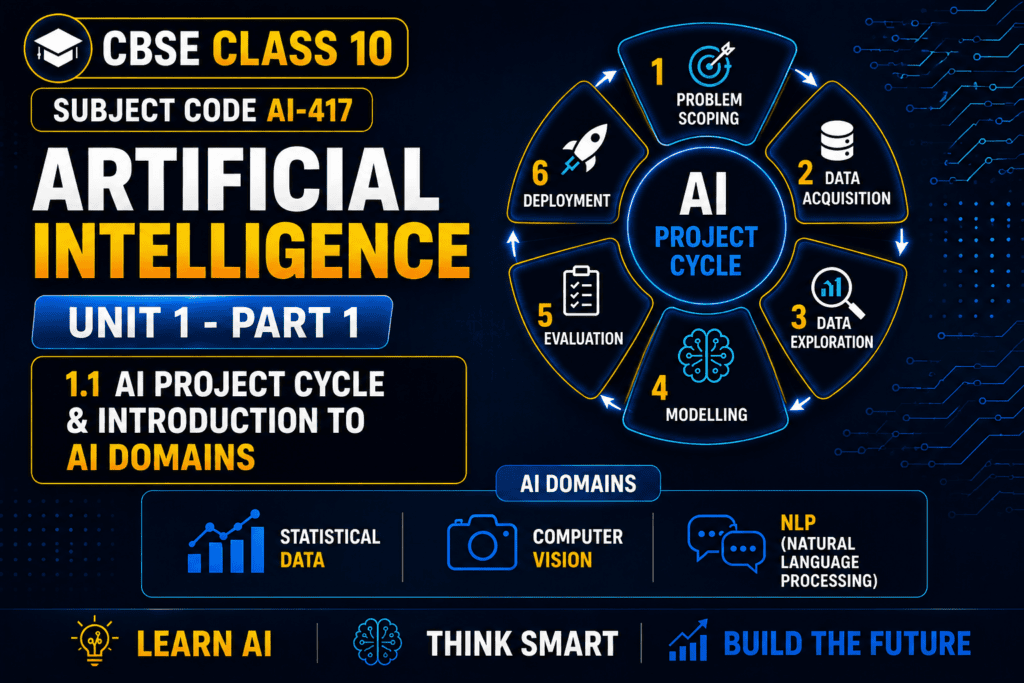
| Revisiting AI Project Cycle & Ethical Frameworks for AI (7 Marks) | 1.1 AI Project Cycle & Introduction to AI Domains | Unit 1.1
| Unit 1.1 Video |
| 1.2 Ethical Frameworks for AI and Bioethics | Unit 1.2
| Unit 1.2 Video | ||
| Unit 2 | Advanced concepts of Modeling in AI (11 Marks) | 2.1 Revisiting AI, ML and DL
| Unit 2.1
| Unit 2.1 Video |
| 2.2 Modelling: Rule-Based vs. Learning-Based Approaches 2.3 Subcategories of Supervised, Unsupervised and Deep Learning | Unit 2.2
Unit 2.3 | Unit 2.2 Video | ||
| 2.4 Neural Networks – How AI Makes a Decision | Unit 2.4
| Unit 2.4 Video | ||
| Unit 3 | Evaluating Models (10 Marks) | 3.1 Model Evaluation, Train-Test Split, Accuracy & Error | Unit 3.1
| Unit 3.1 Video |
| 3.2 Classification Metrics: Confusion Matrix, Precision, Recall, F1 | Unit 3.2 | Unit 3.2 Video | ||
| Unit 4
| Statistical Data (Assessed via Practical) | 4.1 Statistical Data & No-Code AI Tools | Unit 4.1 | Unit 4.1 Video |
| 4.2 Orange Data Mining Walkthrough: Palmer Penguins Case Study | Unit 4.2 | Unit 4.2 Video | ||
| Unit 5 | Computer Vision (4 Marks) | 5.1 Introduction to Computer Vision & CV Tasks | Unit 5.1 | Unit 5.1 Video |
| 5.2 No-Code CV Tools: Lobe, Teachable Machine & Smart Sorter | Unit 5.2 | Unit 5.2 Video | ||
| 5.3 Convolution, CNNs & Python Libraries for CV | Unit 5.3 | Unit 5.3 Video | ||
| Unit 6 | Natural Language Processing (8 Marks) | 6.1 Introduction to NLP, Applications & Chatbots | Unit 6.1 | Unit 6.1 Video |
| 6.2Text Processing (BoW, TF-IDF) & Sentiment Analysis Walkthrough | Unit 6.2 | Unit 6.2 Video | ||
| Unit 7 | Advance Python (Assessed via Practical) | 7.1 Advanced Python: Jupyter Notebook & Python Basics | Unit 7.1 1. System setup 2. Data Types 6. Numpy 7. Pandas | Unit 7.1 Video |
Units 4 and 7 carry no separate theory marks; they are assessed entirely through the Part C practical examination.
PART C: Practical Work
Part C consists of practical work covering Statistical Data, Computer Vision, NLP, and Advanced Python. This is where you build your practical file, sit for the practical examination, and appear for viva voce.
| PRACTICAL WORK | MAX. MARKS |
| Practical File (Minimum 15 Programs) | 15 |
| Practical Examination Unit 4: Statistical Data Unit 5: Computer Vision Unit 6: Natural Language Processing Unit 7: Advance Python | 15 |
| Viva Voce | 5 |
| Total | 35 |
Suggested Practical Programs
- Adding elements of two lists
- Calculating mean/median/mode with NumPy
- Plotting line and scatter charts, reading and exploring a CSV file
- Write a program to find the factorial of a given number
- Write a program to calculate the sum of all even numbers from 1 to 100.
PART D: Project Work
Part D is the project work in which students build an AI solution, participate in fieldwork, or expand their portfolio from Class 9, ideally tied to a Sustainable Development Goal.
| PROJECT WORK | MAX. MARKS |
| Project Work / Field Visit / Student Portfolio, relate it to Sustainable Development Goals | 10 |
| Viva Voce (Project related) | 5 |
| Total | 15 |
Sample Project Ideas
- Statistical Data: Titanic Survival Prediction. No-Code AI: Build AI Models Without Writing a Single Line of Code | Part 1 of Unit 4 | Class 10 – YouTube
- Computer Vision: Make an AI Sorter to sort between Bottles, cans, and plastic bags. Here is the link to the video where we implemented this. Build an AI Sorter Without Writing Code! (No-Code CV Tools) | Part2 of Unit 5 | Class 10 – YouTube
- NLP: Sentiment analysis
Grand Total = PART A + PART B + PART C + PART D = 100 Marks
Conclusion
This course is designed for Class-10 students who have completed the Class-9 AI foundation and are ready to go deeper into modelling, evaluation, ethics, and Python-based AI projects, rounding off their skill-based AI learning journey.
Stay Tuned!!
Stay tuned for Artificial Intelligence Class 10 content in a simplified and practical manner.
Click below for the YouTube video:
Keep learning and keep implementing!!