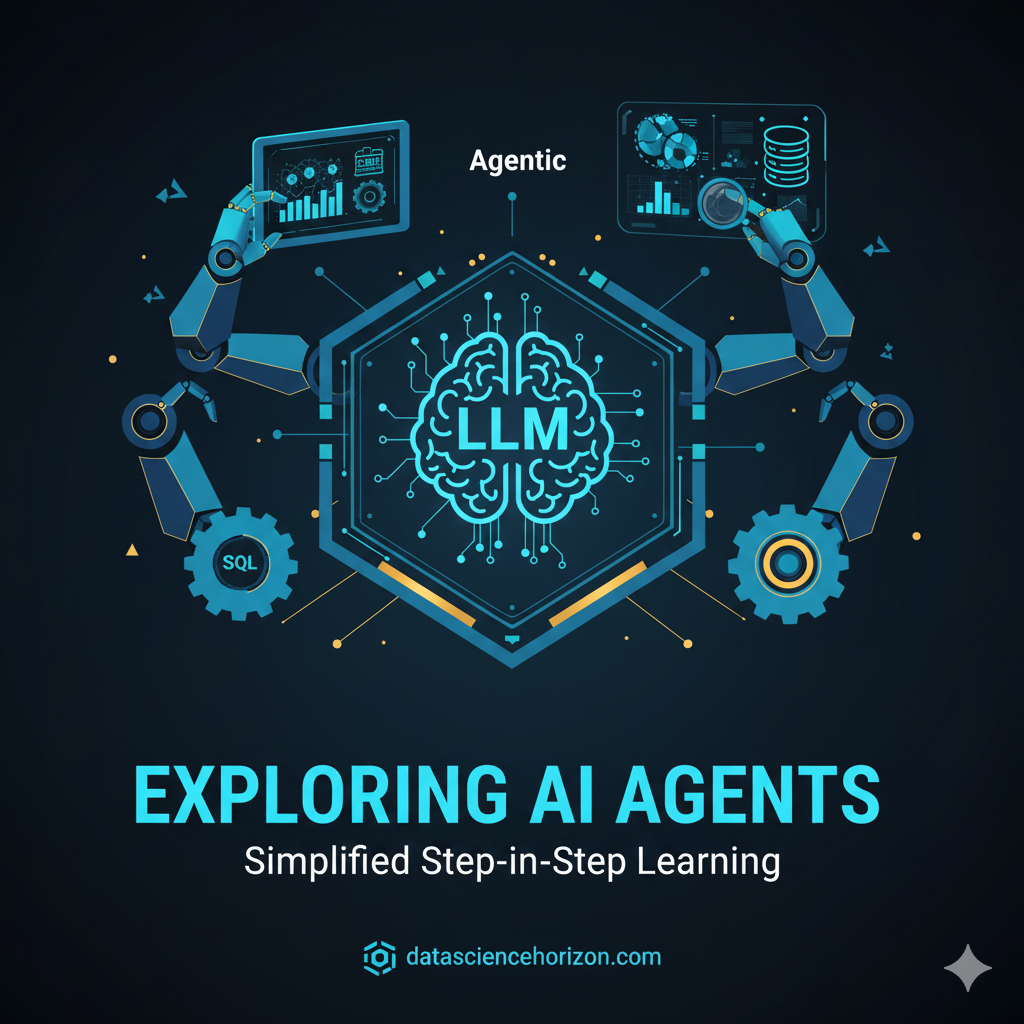
In this article, we explore AI Agents using a simplified, step-by-step learning approach.
Table of Contents
- Introduction
- What are AI Agents?
- From LLM to AI Agents
- Core Components of AI Agents
- Internal Functioning of AI Agents
- Real-World Applications of AI Agents
- Conclusion
1. Introduction
The evolution of artificial intelligence has moved beyond passive responses to active, autonomous problem-solving.
The landscape of Artificial Intelligence is experiencing a seismic shift. We are moving away from an era where AI merely answers questions and entering a new epoch where AI gets things done. This transition is driven by the rise of AI Agents.
If Large Language Models (LLMs) like ChatGPT or Gemini are the “brains” capable of reasoning and generating text, AI Agents are the “hands and feet” that allow this brain to interact with the real world, use tools, and accomplish complex, multi-step goals.
In this comprehensive 2000-word guide, we will break down the concept of AI Agents step-by-step, exploring their architecture, how they evolved from basic LLMs, their internal functioning, and the profound impact they are having on real-world applications.
2. What are AI Agents?
At its core, an AI Agent is an autonomous software system designed to perceive its environment, make decisions based on its programmed logic or learned models, and execute actions to achieve a specific, predefined goal.
Unlike traditional software that follows a rigid, hardcoded “if-then-else” script, an AI Agent leverages the reasoning capabilities of a foundation model to dynamically figure out how to solve a problem.
Key Characteristics of an AI Agent:
- Autonomy: Agents can operate without continuous human intervention. Once given a goal (e.g., “Research the top 5 emerging tech trends of 2026 and write a summary”), the agent works independently to complete it.
- Reactivity: They can perceive changes in their environment (like an error message from an API or a new piece of data) and adjust their behavior accordingly.
- Proactiveness: Rather than just waiting for a prompt, advanced agents can take the initiative to perform tasks that align with their overarching goals.
- Tool Usage: They are not confined to their internal knowledge base. They can browse the web, execute code, query databases, and use third-party APIs.
The “Brain in a Jar” Analogy: Imagine a super-intelligent brain sitting in a glass jar. It knows everything about the world up to a certain date, but it cannot see what’s happening outside, nor can it pick up a pen to write. That is a standard LLM.
Now, imagine taking that brain and putting it into a robot equipped with cameras (perception), hands (tools/actuators), and a notebook (memory). The robot can now look around, decide to bake a cake, read a recipe, gather ingredients, and physically bake it. That is an AI Agent.
3. From LLM to AI Agents
To understand AI Agents, we must trace the evolutionary steps from standard text generators to autonomous actors. The journey from pure LLMs to Agents is a story of expanding capabilities and bridging the gap between “knowing” and “doing.”
Stage 1: The Vanilla LLM (The Oracle)
Early foundation models were essentially highly advanced autocomplete engines. You asked a question, and it provided an answer based on its training data.
- Limitations: They suffered from hallucinations, had a knowledge cutoff, and possessed zero ability to verify facts in real-time or perform physical/digital actions. If you asked it to “book a flight,” it would write a script about booking a flight, but it couldn’t actually book it.
Stage 2: Prompt Engineering & RAG (The Scholar)
To make LLMs more useful, developers introduced techniques like Retrieval-Augmented Generation (RAG).
- How it works: Before the LLM answers, a system searches a database for relevant company documents or recent news, injects that context into the prompt, and asks the LLM to answer based only on that context.
- Improvement: This solved the knowledge cutoff issue and reduced hallucinations, but the system was still purely reactive and conversational.
Stage 3: The AI Agent (The Employee)
The final leap involves taking the RAG-enabled LLM and wrapping it in an autonomous loop with access to external tools. Instead of the human orchestrating every step, the LLM itself is prompted to become the orchestrator.
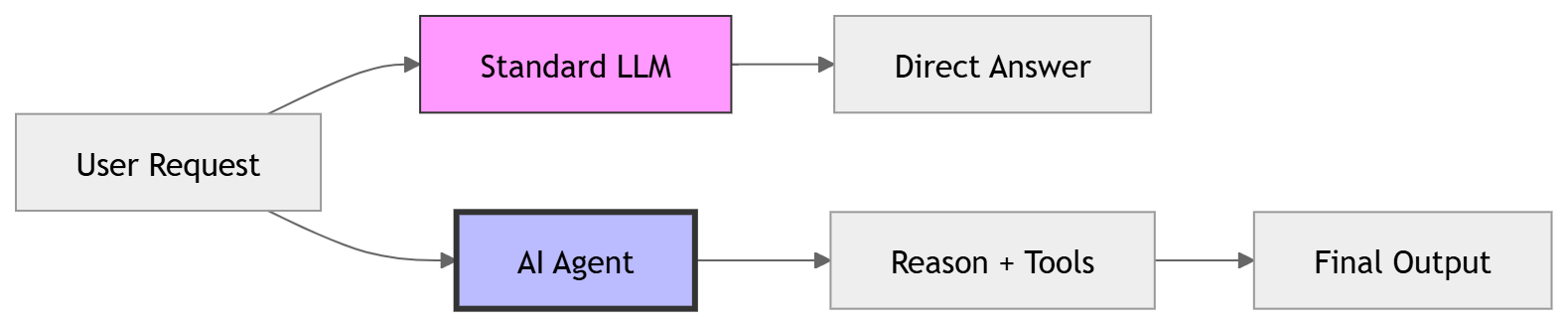
- The Paradigm Shift: The LLM is given a system prompt like: “You are an autonomous agent. You have access to a Calculator, a Web Browser, and an Email Client. When given a task, break it down, use the tools necessary, and do not stop until the task is complete.”
- The Result: The system transforms from a passive conversationalist into an active problem solver.
4. Core Components of AI Agents
An AI Agent is not a single model; it is a composite system—an architecture. To function effectively, an AI agent relies on four foundational pillars.
A. The Brain (Reasoning Engine)
The core of modern AI agents is usually an advanced Large Language Model (like GPT-4, Gemini 1.5 Pro, or Claude 3.5 Sonnet).
- Function: It acts as the central processing unit. It interprets the user’s intent, plans the sequence of actions, decides which tools to use, and processes the output from those tools.
- Capabilities Required: High logical reasoning, ability to follow complex multi-step instructions, and strong contextual understanding.
B. Memory (Context Retention)
For an agent to perform complex tasks over time, it must remember what it has done. Memory is divided into two categories:
- Short-Term Memory: This is the immediate context window of the LLM. It tracks the ongoing conversation, the immediate tasks it just executed, and the current state of its plan.
- Long-Term Memory: This allows the agent to retain information across days, weeks, or months. It is typically implemented using Vector Databases (like Pinecone, Milvus, or ChromaDB). When an agent needs to recall past interactions, it queries the vector database to retrieve relevant memories.
C. Tools (Actuators)
Tools are the defining feature that separates agents from standard chatbots. They are the software equivalents of hands and eyes.
- Information Gathering Tools: Web search (Google/Bing APIs), Wikipedia scrapers, database SQL query executors.
- Action Execution Tools: API integrations to send emails (SendGrid), create calendar events, interact with CRMs (Salesforce), or trigger Slack messages.
- Computational Tools: Python code interpreters to run data analysis scripts, or calculators for precise math.
D. Planning & Strategy
An agent must know how to tackle a problem. Planning involves breaking a massive goal into digestible sub-tasks.
- Task Decomposition: Breaking “Organize a dinner party” into “Determine budget,” “Create guest list,” “Find recipes,” and “Order groceries.”
- Self-Reflection: The ability of the agent to look at its own output, realize it made a mistake, and correct course without human intervention.
5. Internal Functioning of AI Agents
How does an AI Agent actually “think” and operate? The most common framework used to build agents is the ReAct (Reason + Act) framework, which forces the agent to explicitly state its thoughts before taking an action.
Let’s break down the internal loop step-by-step.
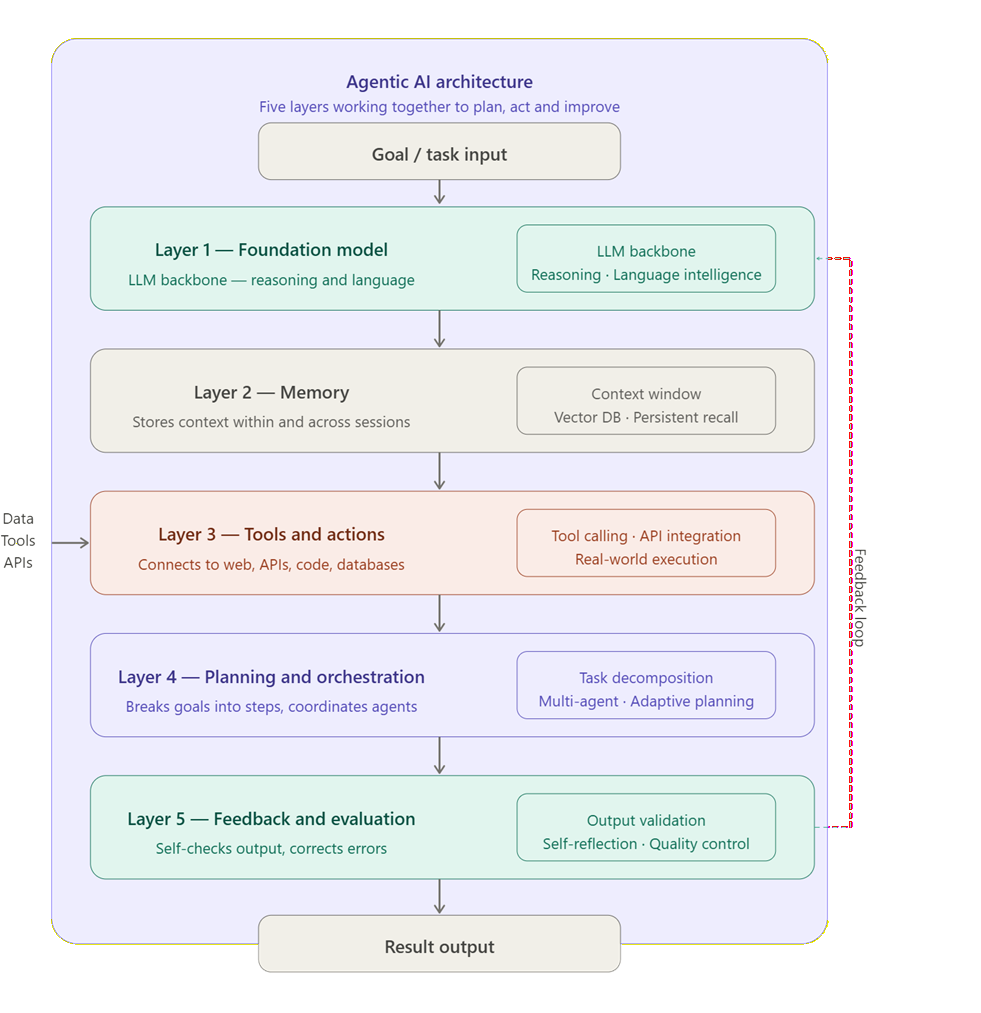
The Agentic AI Architecture Diagram
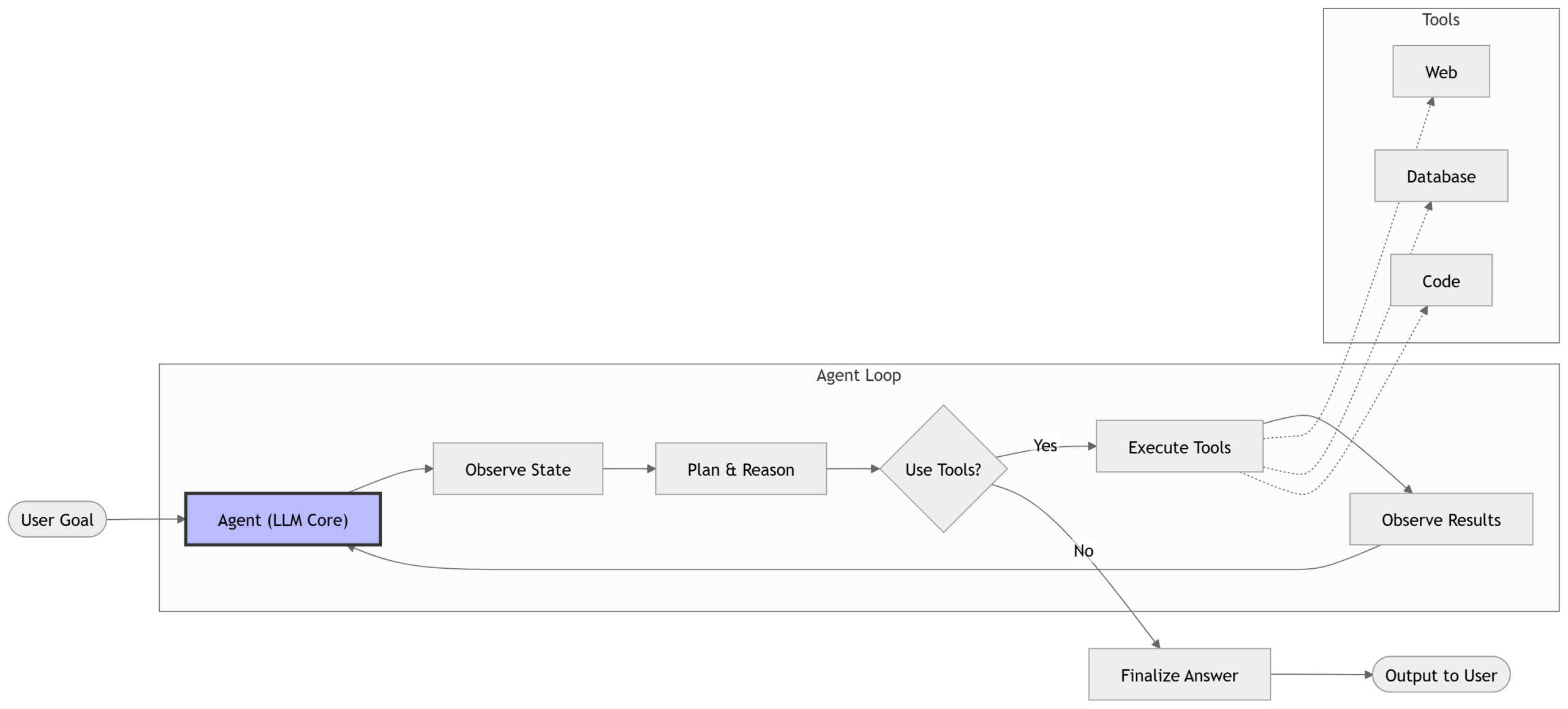
This iterative loop of Thought -> Action -> Observation -> Thought continues until the agent determines that the original goal has been successfully met.
6. Real-World Applications of AI Agents
The theoretical architecture of AI agents is fascinating, but their true value lies in how they are reshaping industries. Because agents can act autonomously, they are moving from novelty tools to enterprise-grade digital workers.
AI Agents are being deployed across industries to automate workflows, analyze data, and assist in software development.
1. Advanced Customer Support (End-to-End Resolution)
Traditional chatbots could only provide FAQ links. AI Support Agents can access a customer’s account, diagnose a problem, issue a refund, and update the CRM—all autonomously.
- Use Case: A customer complains about a missing package.
- Agent Action: The agent checks the tracking API, confirms the package is lost, consults company policy on lost packages, uses the payment API to process a refund, and drafts a personalized apology email to the customer.
2. Autonomous Software Development
Coding agents like Codex or open-source alternatives like AutoGPT and MetaGPT are revolutionizing software engineering.
- Use Case: A developer asks the agent to “build a basic Python web scraper for real estate prices.”
- Agent Action: The agent writes the code, opens a sandboxed environment, attempts to run the code, reads the error logs if it fails, debugs its own code, re-runs it, and finally delivers a working script along with documentation.
3. Financial Analysis and Research
In finance, time is money. AI agents are used to monitor markets and synthesize massive amounts of data instantly.
- Use Case: An investment analyst asks for a report on the electric vehicle sector’s Q3 performance.
- Agent Action: The agent scrapes the SEC filings of Tesla, Rivian, and BYD. It extracts revenue numbers, drops them into a Python script to generate comparative growth charts, and writes an executive summary highlighting key risks.
4. Personal Productivity Assistants
The next generation of Siri or Google Assistant will be true agents.
- Use Case: “Plan my business trip to London next week.”
- Agent Action: The agent checks your calendar for dates, browses flight APIs to find tickets within your preferred airline network, accesses your credit card info securely to book the flight, finds a hotel near your meeting location, and adds the itinerary to your calendar.
See the AI Agent implementation on the future of aviation intelligence by clicking on the link here.
5. Cybersecurity and Threat Detection
Agents are becoming vital in defending digital infrastructure by actively monitoring and responding to threats at machine speed.
- Use Case: Detecting a potential DDoS attack.
- Agent Action: The agent monitors server logs, notices anomalous traffic, cross-references the IP addresses with known threat databases, and autonomously updates firewall rules to block the malicious traffic while alerting the human admin.
7. Conclusion
The transition from Large Language Models to AI Agents represents one of the most significant leaps forward in artificial intelligence. We are moving from an era of knowledge retrieval to an era of autonomous execution.
Simplifying the adoption of AI agents is no longer just a technical challenge; it is the key to unlocking unprecedented levels of human productivity and innovation in the digital age.
Stay Tuned!!
Explore the articles below for the complete implementation of AI Agents.
Building an AI Agent to Detect and Handle Anomalies in Time-Series Data
Keep learning and keep implementing!!
Disclaimer: This article has been written with the help of an AI tool.